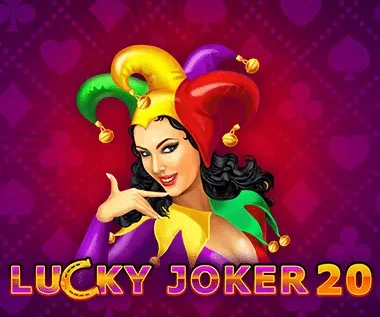

Lucky Joker 20

At 95.95% RTP, Lucky Joker 20 leaves a 4.05% house edge across infinite play. Over 1,000 spins at 1 credit per spin, theoretical expected return sits at 959.50 coins. The expected-value cost equals 40.50 coins before variance.
This Amatic Industries video slot uses 5 reels, 3 rows, and 20 paylines. The math is easier to audit than variable-way or cluster-pay games. Short sessions, however, can still drift far from long-run return.
This is a classic-style Amatic Industries slot with fruit symbols, Joker logic, Wilds, Scatters, and Expanding Symbols. The game runs on a fixed 5 × 3 grid, so each spin has a stable payline structure. Its main numerical benchmark is the 95.95% RTP.
RTP is not a promise for one session. It describes long-run return over very large samples. Therefore, the useful question is not whether one spin pays, but how stake size changes exposure.
| Metric | Verified value |
|---|---|
| Developer | Amatic Industries |
| Type | Video slot |
| RTP | 95.95% |
| House edge | 4.05% |
| Reels and rows | 5 reels × 3 rows |
| Paylines | 20 paylines |
| Bet range | 0.2 to 30 coins |
| Features | Wild, Expanding Symbols, Scatter symbols, RTP range |
This review treats the game as a probability distribution. The measurable model starts with RTP, house edge, paylines, and stake range. Because the listed volatility and maximum win are not stated here, the safest reading is narrow: use the confirmed figures, then verify the paytable before treating any session plan as complete.
The design uses Bell, Fruit, Grapes, Horseshoe, Joker, Lemon, Plum, Star, Violet, and Watermelon symbols. That symbol set gives fast outcome recognition. It also keeps the screen readable during quick spin cycles.
The Joker has more than decorative value because Wild behavior is listed by Amatic Industries. Fruit, bell, horseshoe, and star symbols support simple payline checking. This structure reduces interpretation cost after each wager.
Sound and animation should be treated as interface signalling. They do not change expected value. The relevant design question is whether symbols make winning lines easy to read.
🎯 Did You Know? The horseshoe became a luck symbol through old ironworking traditions. Iron was often treated as protective, which helped the symbol enter casino iconography.
The theme contributes through readability, not novelty. This title uses familiar classic symbols to make paylines and feature events easier to parse. A simple symbol set also makes bankroll tracking less distracting because players can separate ordinary line hits from feature-related outcomes without scanning a crowded screen.
The classic presentation also matters for auditing outcomes. When a slot uses a fixed grid and recognizable symbols, the player can compare the stopped reels with the paytable more quickly. That does not improve the return percentage, but it reduces confusion around which symbol paid, which line was active, and whether a feature symbol changed the result.
Gameplay follows a direct sequence. Choose a stake from 0.2 to 30 coins, spin 5 reels, then read outcomes across 20 paylines. Wilds, Scatters, and Expanding Symbols can modify how results form.
The 20-payline layout matters because each wager spreads across fixed line paths. It does not create Megaways, cluster pays, or cascading wins. Therefore, the paytable should guide every real-money decision.
Stake exposure scales quickly. At 0.2 coins, 100 spins wagers 20 coins. At 1 credit, 100 spins wagers 100 coins. At 30 coins, 100 spins wagers 3,000 coins.
⚡ Quick Fact: At 95.95% RTP, every 1,000 coins wagered carries theoretical return of 959.50 coins before variance.
The same expected-value logic applies at any stake. A 100-credit total wager has theoretical return of 95.95 coins. The expected loss equals 4.05 coins over the long-run model.
💡 Pro Tip: Check the in-game paytable before staking. Exact Wild, Scatter, and Expanding Symbol rules define the real probability map.
Mechanically, the slot is straightforward. It combines 5 reels, 3 rows, 20 paylines, and a 0.2 to 30 coins betting range. The fixed structure makes the cost of each spin clear because the stake shown before the spin is the amount exposed to the 95.95% return model.
For practical review, the spin process should be treated as three checks. First, confirm the chosen stake and whether all 20 lines are active. Second, read the paytable so symbol payouts are known before the reels stop. Third, separate a normal line win from any Wild, Scatter, or Expanding Symbol effect because feature rules can change the visible result.
Amatic Industries lists Wild, Expanding Symbols, Scatter symbols, and RTP range. That is a compact feature set. It modifies line completion without adding heavy bonus architecture.
Wild symbols can improve line-completion probability where the paytable allows substitution. That changes the distribution of small and medium outcomes. However, exact substitution limits belong in the live paytable.
Expanding Symbols can affect several reel positions at once. One expansion event may influence multiple paylines. Consequently, this mechanic can widen the variance band within base-game play.
Scatter symbols often operate differently from regular line symbols. In this title, they deserve attention because they can create non-standard outcome paths. Still, awards and trigger rules should come from the game rules screen.
Players searching free spins should separate search intent from verified mechanics. The listed features include Scatters, yet a traditional free-spins round should not be assumed. Likewise, feature buy, ante bet, and cascade mechanics should not be added by inference.
The confirmed feature set is lean and mathematical. Wilds, Scatters, and Expanding Symbols reshape the base-game probability structure.
The most important feature question is not the name of the symbol but the rule attached to it. A Wild that substitutes for most symbols has a different effect from one that excludes top symbols or Scatters. A Scatter that pays anywhere has a different risk profile from one that only triggers a screen event. An expanding rule can be modest or material depending on when it activates, which reels it covers, and whether it pays before or after expansion.
Because those details sit inside the game rules, feature value should not be estimated from the label alone. A compact feature list can still produce sharp outcome swings if the symbol weighting is uneven. The prudent approach is to read the paytable, note the highest-paying symbols, and then check whether Wild or expanding behavior can interact with those symbols.
Lucky Joker 20 RTP is 95.95%, according to Amatic Industries. That leaves a 4.05% house edge. The figure describes long-run average return, not the next spin.
The house edge matters because every stake size keeps the same percentage cost. Raising stake increases credit exposure. It does not improve the expected-value percentage.
⚠️ Caution: A known RTP cannot fully model session risk by itself. Paytable review remains essential before real-money play.
At 0.2 coins over 500 spins, total wager equals 100 coins. The theoretical expected return equals 95.95 coins. The expected-value cost equals 4.05 coins.
At 1 credit over 500 spins, total wager equals 500 coins. The theoretical expected return equals 479.75 coins. The expected-value cost equals 20.25 coins.
At 30 coins over 500 spins, total wager equals 15,000 coins. The theoretical expected return equals 14,392.50 coins. The expected-value cost equals 607.50 coins.
These figures are accounting models. Actual outcomes can sit materially above or below expectation over short samples. Variance, not RTP alone, drives that session gap.
The same calculation can be scaled to any session size. A 250-credit total wager has a theoretical return of 239.875 coins and an expected-value cost of 10.125 coins. A 2,000-credit total wager has a theoretical return of 1,919 coins and an expected-value cost of 81 coins. The percentage stays fixed, while the number of coins at risk grows with the total amount staked.
A risk model needs more than RTP. Hit frequency, bonus frequency, volatility class, and payout ceiling all sharpen bankroll planning. Without those inputs, the safest approach is conservative stake sizing.
Twenty paylines do not automatically mean frequent wins. More lines can create more evaluated paths, yet symbol weighting controls real hit rate. Therefore, line count should not replace the paytable.
The payout profile can be quantified by RTP and house edge. Its full risk shape still depends on operator rules and in-game tables. If the paytable shows a steep jump between low symbols and top symbols, the bankroll plan should allow for longer dry sections. If awards are flatter, the experience may feel steadier, but that still needs confirmation from the actual rules screen.
A useful personal limit can be built from total wager rather than session time. For example, a player who wants to risk the expected-value cost on no more than 200 coins of turnover should stop once 200 coins have been staked, regardless of whether that takes many small spins or fewer larger spins. This method keeps the exposure calculation tied to RTP rather than mood or streaks.
Search behavior around this game often includes line-count variants and related lucky themes. That does not prove a formal sequel chain. It does show that players compare fixed-line formats.
Nearby classic or lucky-themed titles include Lucky Tribe 20, Lucky Xmas 20, Lucky Crown 20, and Lucky 20 Bells. Treat them as related navigation points, not interchangeable math models. Each game needs its own RTP, stake range, feature list, and paytable check.
The strongest comparison basis here is structural. This title uses a 5 × 3 grid, 20 paylines, 95.95% RTP, and Wild, Scatter, and Expanding Symbol features. Those facts should not transfer to another title without verification.
Classic fruit slots often share symbols and reel rhythm. However, shared iconography does not mean shared expected value. RTP and feature rules carry more weight than theme family.
This Amatic Industries review therefore compares by mechanics, not assumed series status. The reliable comparison points are paylines, RTP, stake range, and listed features.
When comparing related titles, the first step is to separate theme from math. A matching line count can make two games look similar, yet reel strips, symbol weights, top awards, and feature triggers may differ. A comparison only becomes useful after the same categories have been checked across each title: return percentage, active paylines, minimum stake, maximum stake, Wild rules, Scatter rules, and any stated volatility indicator.
A 5 × 3 slot grid usually maps cleanly to mobile screens. Touch controls should make stake selection and spinning simple. Still, the paytable matters more than screen size.
Desktop play gives more space for tracing paylines. It also helps when reviewing Wild rules, Scatter awards, and Expanding Symbol behavior. Interface comfort can improve rule reading, but it cannot change expected value.
If the same certified version runs across devices, RTP should remain stable. The screen changes usability, not the probability distribution. Operators should present the same game math across approved platforms.
Free play can help with controls and payline recognition. Demo sessions, however, cannot validate long-run volatility. A small sample never proves the distribution.
Download searches should be handled carefully. Many casino games run in-browser, so downloads may add avoidable security risk. Licensed platforms and visible paytables matter more than file access.
Where regulation matters, check operator licensing and local legality. The New Jersey Division of Gaming Enforcement is one example of a regulator with public oversight standards. Adults only, 18+, and local rules apply.
Mobile and desktop differences are mainly ergonomic. The mathematical model should stay tied to the certified game version. A demo session is still useful for checking whether the stake controls are clear, whether the line display can be read on a small screen, and whether the paytable opens without hiding key feature text.
Before wagering on any device, compare the visible game name, provider, RTP, and rule screen. If the operator interface does not show the same core information, pause the session. The reviewable facts are only helpful when the casino page presents the correct game and makes its rules accessible before a real-money spin.
Strategies should start with a negative expected value. No staking pattern changes 95.95% RTP. Increasing stake changes exposure, not the return percentage.
A conservative trial uses a 100-credit bankroll at 0.2 coins per spin. That gives 500 spins of exposure. The same bankroll at 1 credit gives only 100 spins.
At 30 coins per spin, a 100-credit bankroll covers very few spins. That stake compresses variance into a short sample. Therefore, high stakes need a much larger bankroll.
A 50-credit test bankroll should stay near minimum stake. At 0.2 coins, it supports 250 spins. A practical stop-loss could sit around 25 coins.
A 100-credit bankroll supports a wider plan. At 0.2 coins, it creates 500 spins of exposure. At 1 credit, it creates 100 spins, so loss limits should be tighter.
A 500-credit bankroll gives more room for paytable study. At 1 credit, it supports 500 spins. At 30 coins, it still covers fewer than 17 spins, which is thin sampling.
No-deposit promotions require separate analysis. Bonus terms come from casinos, not the slot engine. Check wagering rules, maximum bet limits, withdrawal caps, and excluded games.
Real money play belongs only at licensed casinos with visible RTP and rules. If gambling stops feeling controlled, BeGambleAware offers problem-gambling support and guidance. Strategy ends where loss control fails.
🎯 Did You Know? Provably fair crypto games may use hashes for outcome auditing. Traditional supplier slots usually rely on certified RNG testing and regulation instead.
The correct strategy is bankroll mathematics. Stakes should follow exposure, RTP, and promotion rules rather than pattern belief.
A practical session plan can be written before opening the game. Set the starting bankroll, maximum stake, stop-loss, and stop-win in coins. Then decide the maximum total turnover for the session. This avoids raising stake after losses and avoids treating a short winning run as proof that the game has changed.
Promotion play needs even more discipline. A bonus may lower cash exposure, but wagering requirements can create large turnover. If a promotion limits maximum stake, the player should treat that rule as part of the bankroll plan. Breaking a bonus rule can void winnings even when the spin result itself looks valid.
The player experience is fixed-line, readable, and comparatively simple. This Amatic title avoids the complexity of modern multi-feature slots. That makes the probability surface easier to explain.
The slot’s strongest property is measurable RTP. A 95.95% long-run return and 4.05% house edge create a clear benchmark. However, the paytable must still settle feature details.
Classic-symbol play also keeps outcome review quick. Fruit and Joker icons are easy to distinguish. Therefore, attention can stay on stake, line wins, and feature symbols.
The weaker side is model completeness. Without full public figures for every risk input, bankroll estimates need margin. A cautious player treats missing parameters as reasons to lower exposure.
Player experience is best described as transparent but incomplete. The game gives clean payline structure, while some payout modelling depends on the live rules screen.
For review purposes, that balance is important. The title is not difficult to understand, but easy presentation should not be mistaken for low risk. A fixed-line format can still produce uneven results when the top awards are rare or when feature symbols appear irregularly. The visible structure helps the player read outcomes; it does not remove variance.
The RTP is 95.95%. That means the house edge equals 4.05% over the long-run model. At 1,000 coins wagered, theoretical return equals 959.50 coins before variance.
Select a stake from 0.2 to 30 coins. Then spin the 5 reels and 3 rows. Winning outcomes are read across 20 paylines, with Wilds, Scatters, and Expanding Symbols involved.
Amatic Industries lists Wild, Expanding Symbols, Scatter symbols, and RTP range. The rules screen should decide whether any operator version adds a free-spins-style rule. Do not infer it from Scatters alone.
The listed mechanics include Scatter symbols and Expanding Symbols. Exact trigger conditions should be checked in the live paytable. Avoid treating promotion text from another variant as this game’s rule set.
The practical answer belongs in the live paytable. This review avoids quoting a multiplier because Amatic Industries must anchor that figure. Conflicting third-party numbers should not replace the game rules screen.
The official materials used here do not assign a low, medium, or high class. That limits short-term bankroll modelling. Therefore, stake sizing should remain conservative until the paytable gives fuller risk detail.
Real-money access depends on licensed casino availability in the player’s jurisdiction. Check local rules, operator licence, visible RTP, and paytable before wagering. The game’s house edge remains negative in expectation.
Free play helps with buttons, paylines, and feature recognition. It does not predict real-money outcomes. It also cannot replace official rules for volatility or payout ceilings.
Lucky Joker 20 is a clean 20-payline Amatic Industries slot with a known 95.95% RTP. Its 4.05% house edge can be modelled directly. The main limitation is incomplete public risk detail beyond the listed mechanics.
⭐ Our Verdict
This is a mathematically readable classic slot. The fixed grid, 20 paylines, and clear RTP create a usable expected-value frame. Conservative staking remains necessary because the full payout shape needs paytable review.
👥 Best For: Analytical classic-slot play with fixed paylines and visible RTP math. Low-stake bankroll testing makes more sense than aggressive exposure. The strongest use case is paytable-led play, not bonus chasing.
This review is verified periodically against the latest game data and casino paytables. Lucky Joker 20 earns a measured verdict: simple structure, useful RTP clarity, and a risk model that still needs live-rule confirmation.
Ready to play Lucky Joker 20 for real money? Start at one of our top-rated crypto casinos, crypto slots sites, the best slots casinos, fast-paying casinos and mobile casinos.
Play responsibly. 18+ only. For free, confidential support visit BeGambleAware.